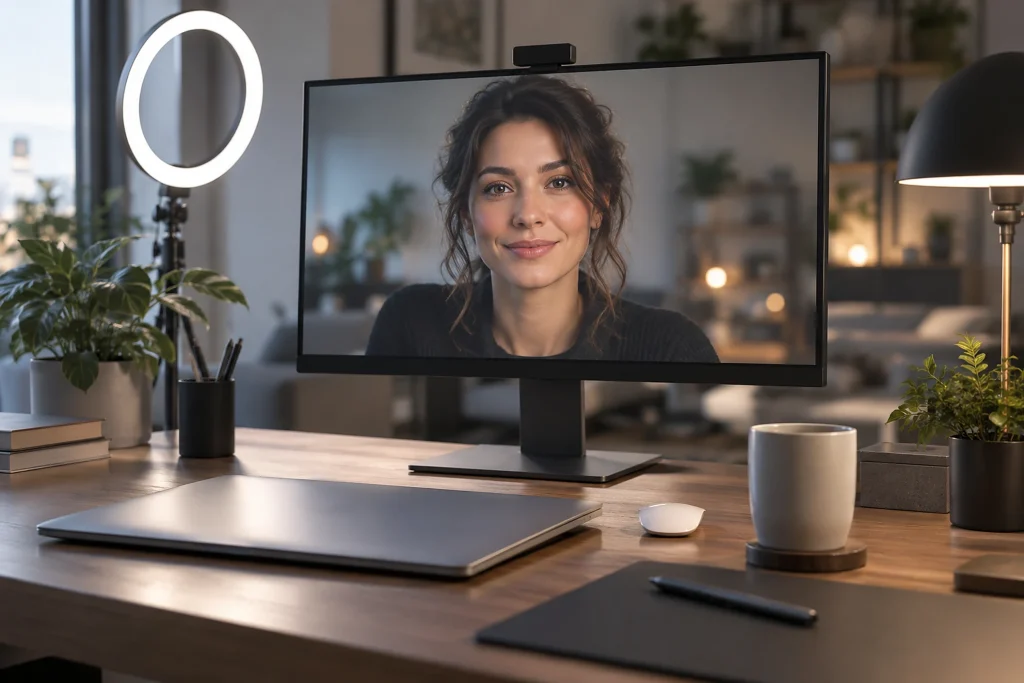
Synthesia’s head of corporate relations, Alexandru Voica, uses an interactive avatar created with his own likeness and voice to answer press questions about the company. The UK-based company operates in the digital avatar space alongside startups such as D-ID, HeyGen and Colossyan. It was reported that Synthesia reached a valuation of $4 billion earlier this year and announced that it had surpassed $100 million ARR last year.
The company enables businesses to create training videos with AI avatars. With its new Roleplay Sessions product, employees can rehearse scenarios such as sales presentations with interactive avatars; the avatars can evaluate and score their responses.
TechCrunch writer Dominic-Madori Davis created her own digital avatar at Synthesia’s New York office. For this, numerous photos of her were taken and a two-minute recording of her voice was made. The company prepared two personal avatars—one with glasses and one without—and two interactive avatars. While the personal avatar reads the provided text, the interactive avatar can listen and respond. Davis’s interactive avatar was trained using her article about why venture-backed startups commit more fraud than other startups and was designed to answer questions only about this topic.
The avatar’s technological operation consists of four stages:
- A speech-to-text model converts what the user says into text.
- An agent-based language model interprets the text and acts accordingly.
- A text-to-speech model converts the response into audio.
- A video model developed by Synthesia animates the avatar as it speaks.
Synthesia’s products are divided into three main groups:
- A video creation and distribution platform that creates videos of the avatar reading text written by the user.
- An agent-based platform called Sessions that provides interactions such as surveys and role-playing.
- An API platform that allows the company’s video and audio models to be integrated with other services.
In addition to its own models, the company also allows the use of models from Cartesia, ElevenLabs, Google, and OpenAI; businesses can host avatars in any cloud they choose or use Synthesia’s hosting service.
Preparing the avatars took several days. Davis found the voice of the personal avatar quite successful, while her friends found the interactive avatar’s appearance and voice somewhat unsettling. The avatar answered only questions related to the startup fraud story on which it had been trained; it also left Davis’s family’s personal questions unanswered.
Davis said the experience raised the question of whether trust in journalism could be delegated to artificial intelligence. She said that having digital copies answer questions on users’ behalf during vacations could be appealing, but that she had mixed feelings about her own avatars.
Why it matters
This development shows that companies could use systems that interact with employees rather than relying solely on videos that employees watch during training and rehearsal processes. In applications such as sales presentations, this could reduce the need for trainers to be involved at every stage of the process by enabling evaluation and scoring functions; however, the avatar’s ability to respond only within a predefined topic framework shows that its areas of use remain limited. The use of the technology in journalism, meanwhile, raises questions about the role of a person’s digital copy in conveying information and the extent to which audiences will trust that copy. The ability to host personal avatars across different clouds and offer various model options creates room for technical choices for businesses, while leaving open the question of how data and the authority to represent someone will be managed.