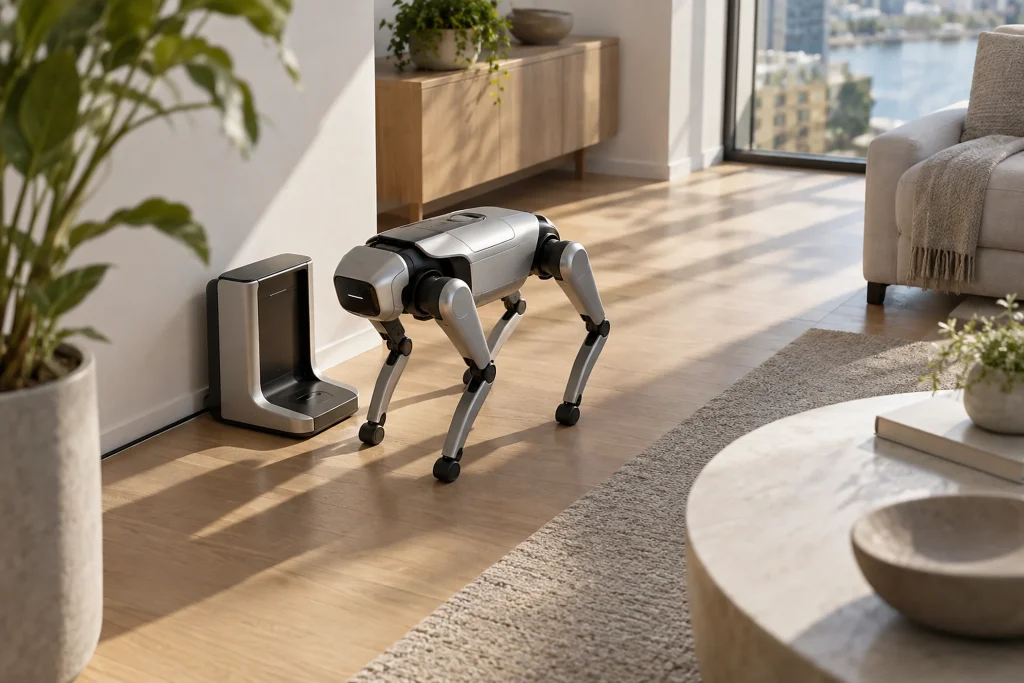
The Go2 Pro robot dog produced by Chinese company Unitree walked approximately two miles with its owner from Mount Pleasant in Washington DC to an office near the White House. However, on the way back, it toppled over a few meters from home when the air temperature was 87°F (30°C), the battery level was 5%, and its internal temperature was 84°C (183°F). The robot can perform movements such as shaking hands, doing a handstand and jumping into the air, but it does not have arms or hands for household chores. Wheeled robots and drones are considered more suitable for tasks such as delivery and inspection.
The robot’s most important advantage is its price. $4,017 was paid for the Go2 Pro, including customs duties and shipping. The Go2 series introduced by Unitree in 2023 starts at $1,600 for the Air model and $2,800 for the Pro model. Boston Dynamics’ Spot model, which is larger and capable of carrying heavier loads, is sold for approximately $75,000. Unitree’s first models, Laikago and AlienGo, were launched in 2017 and 2019, respectively; the Go1 series, launched in 2021, was offered for sale starting at $2,700. This pricing policy has made four-legged robots used in academic research accessible to a broader segment of society.
Unitree founder Wang Xingxing developed a simple robot called XDog for his master’s studies at Shanghai University and drew inspiration from Boston Dynamics. The company uses common parts, low-cost components and easily replaceable legs in its electric-motor-powered robots. It also reduces costs by combining powerful motors with simpler 6.33-to-1 ratio reducers. Tax incentives from the Chinese government and large-scale purchases by public institutions also helped the company expand its production.
Unitree moved from the four-legged robot market into the humanoid robot market. It introduced the H1 in 2023 and the G1 the following year; the consumer-grade G1 starts at $13,500. The company’s humanoid revenue rose from RMB 107 million ($16 million) in 2024 to RMB 867 million ($129 million) in 2025, and these robots accounted for 51% of its revenue in 2025. Unitree’s quadruped revenue also increased from RMB 230 million ($34 million) to RMB 697 million ($104 million) over the same period.
Unitree began trading on the Shanghai Stock Exchange on August 19; its shares rose more than fivefold on the first day, bringing the company’s valuation to $34 billion. However, faulty implementation and limited functionality are among the product’s shortcomings. In the United States, a bill aimed at restricting imports of Chinese robots was introduced in June, while the FCC introduced new regulations for foreign-made robots in July. Despite this, the company aims to lead the global humanoid robot market alongside its competitors in China.
Why it matters
Unitree’s low-cost four-legged robots are making these systems, previously limited primarily to academic research, accessible to a broader user base. However, field experience shows that affordability alone is not enough for everyday use; overheating, battery issues and limited functionality determine the robot’s reliability. The rising share of humanoid robots in the company’s revenue shows that Unitree is moving beyond being merely a robot dog manufacturer and positioning itself in a broader robotics market. While this growth is advancing alongside public support and low-cost manufacturing in China, import restrictions and new regulations being considered in the United States leave an open question about the company’s global reach.
Background
China is not a new name in the FikirPilot archive: we have published 2 news articles mentioning this name in the last 90 days; the latest is dated August 31, 2026.