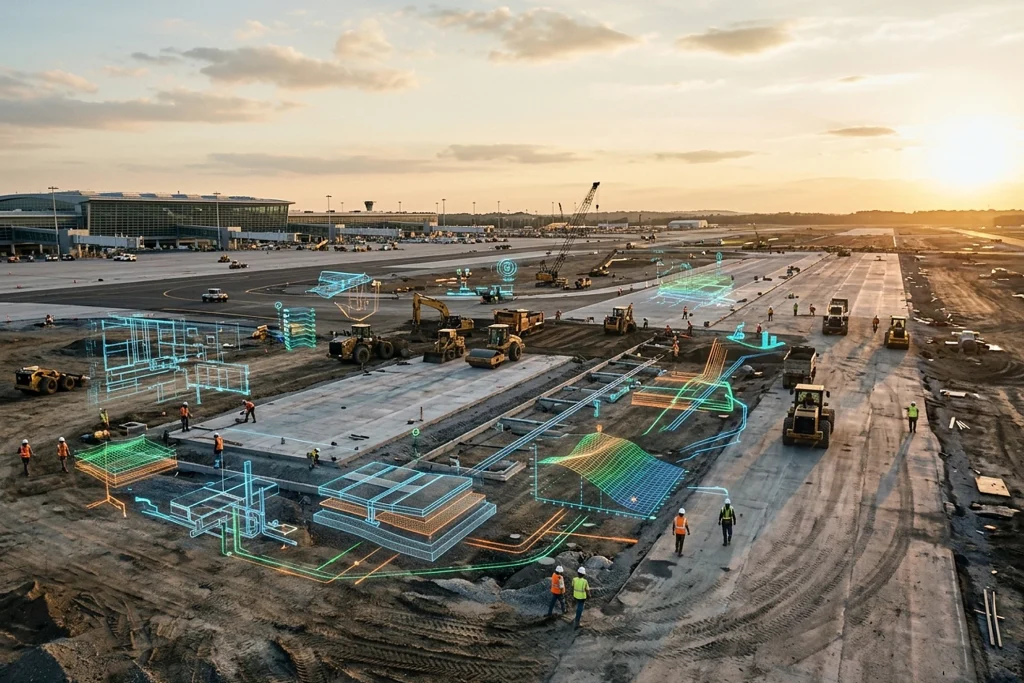
Charlotte’s New Runway Gets a Digital Twin. The first powered airplane took off roughly twenty years before the first real runway, and the aviation world gradually came to grasp the necessity of flat, paved surfaces. Runway technology evolved as well. Now, this project being built in Charlotte aims to push runway technology even further by adding digital capabilities to it.
Charlotte Douglas International Airport (CLT) in North Carolina is a major hub for American Airlines and one of the busiest airports in the country. The airport has three parallel runways. The fourth parallel runway, which broke ground in June 2023, is expected to increase landing and takeoff capacity with its 10,000-foot length. The project is also expected to keep the airport competitive and provide resilience in challenging conditions. While construction is underway, the existing runways have been renamed 19R/1L, 19L/1R, and 18/36. The new runway will carry the designation 19C/1C.
What sets the runway apart is its “smart runway” features. This is not a pointless WiFi connection like the kind found in a smart refrigerator. The goal is to understand the runway’s current condition and how it changes over time in much greater detail through sensing and telemetry. More than 2,000 sensors will be embedded in the 18-inch-deep concrete being laid. The sensors will measure: – strain and deformation – moisture ingress – settlement – friction – presence of snow and ice
Similar sensors have previously been used on highway bridges and roadways. However, this will be the first time a U.S. runway is equipped in this way, and a “digital twin” of the runway will be created. The categories the sensors will measure are as follows:
Similar sensors have previously been used on highway bridges and roadways; however, this will be the first time a U.S. runway is equipped in this way, creating a “digital twin” of the runway. Fed by sensor data, this model will serve to monitor the runway’s condition from an engineering and operational standpoint. While moisture, snow, and ice data will guide de-icing efforts, strain monitoring will inform maintenance decisions and clearly show how aircraft operations affect the runway structure. The strain gauges embedded in the concrete will not be practical to maintain; their expected lifespan is about ten years.
Why it matters
This project shows that the sensing approach tested to date on bridges and roadways is now being carried over to aviation infrastructure. The runway’s transformation from a passive strip of concrete into a system that continuously reports its own condition will allow maintenance and ice-control decisions to be based on direct measurement rather than estimation; that means fewer unplanned closures and delays at one of the country’s busiest airports. The fact that the trial is being conducted at a major airline hub is significant because, if the model proves effective, it will serve as a reference for other airports. On the other hand, the strain gauges’ roughly ten-year lifespan and the fact that they cannot be repaired because they are embedded leave an open question: as the sensors go offline, how much of the digital twin will remain functional?