UCLA researchers have developed a new optical-neural processor that uses light to identify deepfake videos quickly and accurately. While conventional digital systems generally examine videos sequentially, this technology can analyze 15 or more video streams simultaneously in a single optical pass. The study was published in eLight under the title “Scalable, Energy-Efficient Optical-Neural Architecture for Multiplexed Deepfake Video Detection.”
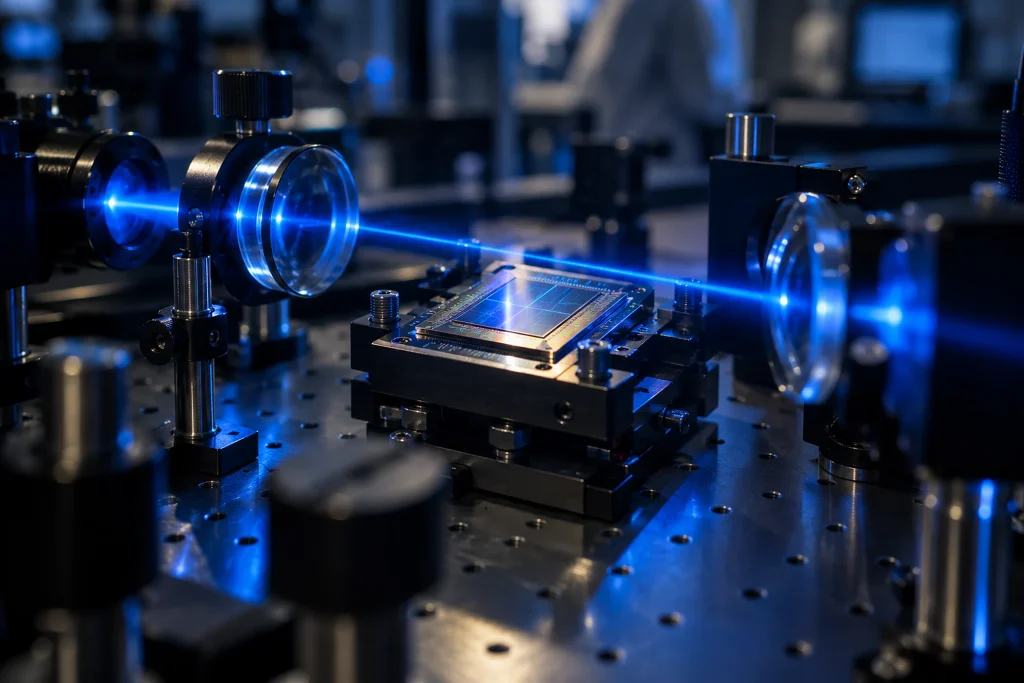
In the system, a lightweight digital encoder converts the spatial, spectral, and temporal features of videos into compact information. This information is translated into a phase pattern on a programmable spatial light modulator. The optical wavefront then passes through a free-space-based passive optical decoder, and paired optical detectors directly produce an authenticity score for each video. In this way, part of the decoding process, which requires intensive digital computation, is performed through the diffraction of light.
In experiments conducted with visible light, the processor examined 15 Celeb-DF videos simultaneously in each optical pass. The average accuracy was 97.79%, sensitivity was 99.86%, and specificity was 95.72%. The false-negative rate corresponding to the sensitivity result was calculated at approximately 0.14%. When the capacity was increased to 18 videos, accuracy remained at 96.13%. In more challenging deepfake manipulations, adding two optimized diffractive layers to the passive optical decoder increased accuracy by approximately 6.8%. These passive structures perform optical computing without requiring additional electrical power.
The researchers also tested the system on previously unseen videos generated with Google’s VEO-3 model. With limited fine-tuning, accuracy was 94.80% and sensitivity was 97.61%. The processor also demonstrated resistance to black-box adversarial attacks and provided hardware-based protection against white-box attacks. It continued to operate under image noise, blurring, JPEG compression, and experimental alignment errors.
The UCLA team designed the system not as a tool to replace advanced digital detectors, but as a first line of defense for scanning high-volume videos. Suspicious content could then be passed on to more detailed digital models. The approach was said to have potential applications in content moderation, media authentication, surveillance, and security-focused artificial intelligence. Parnian Ghapandar Kashani, Dr. Shiqi Chen, and Professor Aydogan Ozcan contributed to the study.
Background
Nearly is not a new name in the FikirPilot archive: we have published 4 reports mentioning this name in the last 90 days; the most recent is dated September 29, 2026.