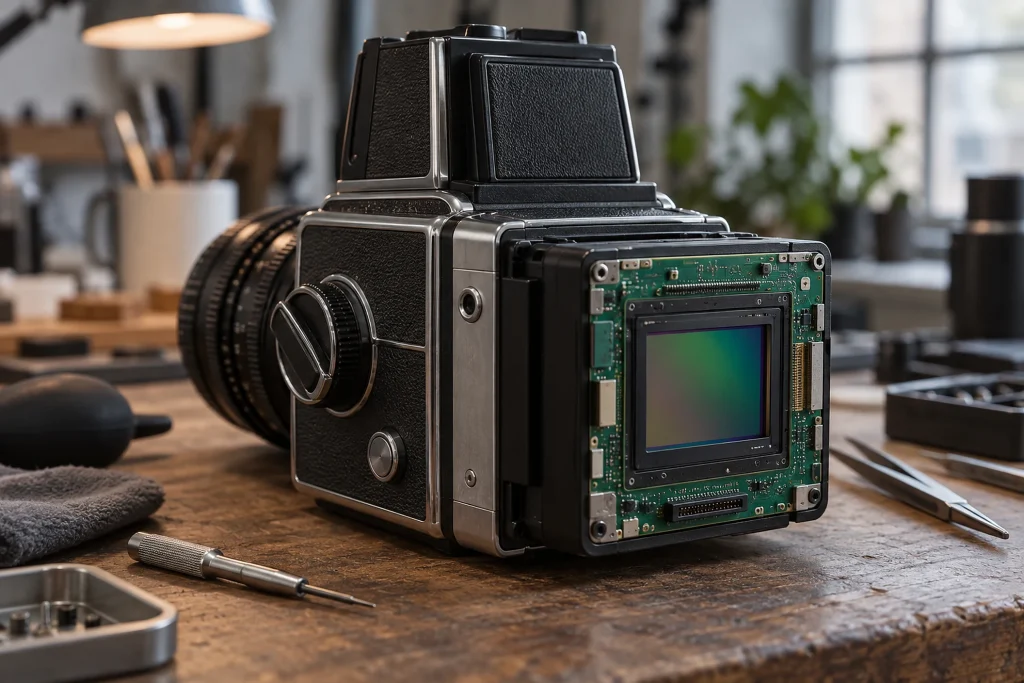
Sitina B220M is an open-source digital back developed by Wenting for the Mamiya Super 23, using a full-frame Kodak CCD. It modifies the back of the camera to replace the film with a sensor. The 22-megapixel Kodak KAF-22000CE sensor measures 38.8 mm x 50 mm, which is close to the 56 mm width of the 120 film it was designed for. The exposed area varies depending on the back, but does not fall below 41.5 mm. The digital system is managed by a Xilinx Zynq 7010, Cortex-A9 cores, and an onboard FPGA. The code is available on GitLab, and the build video explains how it works; the photographs begin at 8:25. Wenting’s previous FPGA projects were an e-ink monitor and a mirrorless camera. This version is less ambitious; it focuses on the digital side while addressing the camera-design issues.
Why it matters
The project focuses on using a film-era body such as the Mamiya Super 23 to produce digital images without completely modifying it, directly appealing to those who want to make use of older photographic equipment. Sharing the open-source code makes it possible to examine how the system works and technically follow similar hardware adaptations. The Kodak CCD’s large surface brings the difference in framing between medium-format film and a digital sensor into focus, while the back determining the exposed area shows that the same field of view may not be obtained in every use case. The open question that will determine the project’s practical value is therefore how much of the sensor can produce images consistently and usefully in different setups; the current work, meanwhile, gives priority to this digital section.