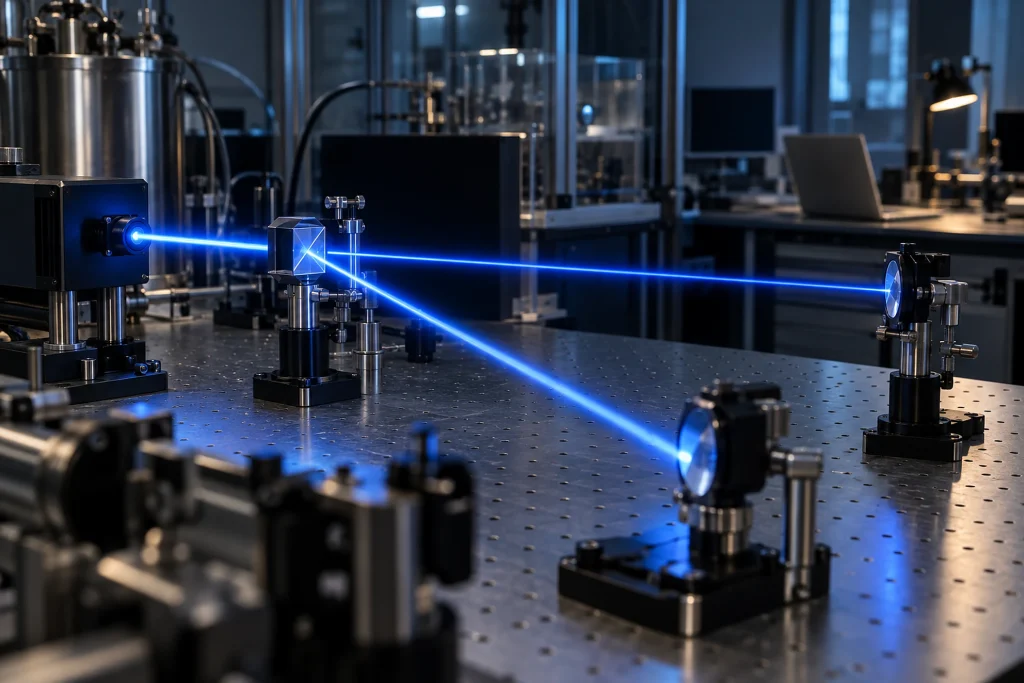
A team led by physicist Ron Folman of Ben-Gurion University of the Negev, comprising researchers from Germany, the United Kingdom and the United States and joined by Nobel laureate Roger Penrose, placed a single atom in a superposition of two different trajectories to study the intersection of quantum mechanics and relativity. In the setup, called the Quantum Galileo Interferometer (QGI), the atom in one path was in free fall while the atom in the other path was held stationary in place. The two paths were merged at the same time and at the same point, allowing the phase difference produced by the fall in the atom’s wave property to be measured.
The wave nature of atoms can be observed only at temperatures close to absolute zero and at very low speeds. Since the phase cannot be measured on its own, a single particle must be split into two trajectories and then recombined. In the free-fall experiment, however, the acceleration of the falling atom could have disrupted quantum interference by providing information about which path it had followed. The team solved this problem by launching one of the atoms upward and allowing it to return to its starting point under gravity, while holding the other stationary in the air using magnetic force. As the falling atom returned, a second magnetic pulse cut its speed at the moment it reached the starting point.
QGI uses microwave and magnetic pulses; approximately 20,000 rubidium atoms are arranged as a Bose-Einstein condensate held by fields generated by microscopic wires on a chip. The chip is positioned upside down, approximately 113 micrometers above the atoms. The maximum distance between the trajectories reached approximately 7.5 micrometers, while the longest flight time reached two-thousandths of a second. The phase was observed to increase as the fall became longer, and the data showed the phase difference predicted by the theory.
The researchers stated that the result demonstrated for the first time that the equivalence principle operates in a system in quantum superposition. The measured phase deviated from the theoretical prediction by 2.5 percent. The team said that the experiment served as a checkpoint for testing the boundary between Einstein’s relativity and quantum mechanics.
Folman’s laboratory is now working on a larger QGI that will place nanodiamonds 10 orders of magnitude heavier than atoms into superposition. The aim is to test the superposition of different spacetime curvatures and observe the quantum collapse predicted by the hypothesis of Penrose and Lajos Diósi. The team hopes this will be possible within four or five years. The study was published in Science Advances in 2026; DOI: 10.1126/sciadv.aec8045.
Why it matters
This study provides experimental support showing that the equivalence principle is not limited to the motion of classical objects and can also be tested for a single system in quantum superposition. For this reason, the result establishes a checkpoint that can be used in research addressing quantum mechanics and relativity together to assess the compatibility between the two theories. The measurement’s 2.5 percent deviation from the theoretical prediction raises the possibility of retesting the method in larger systems. For researchers working particularly at the intersection of quantum physics, gravity, and fundamental physics, the open question is whether this principle will also hold in the superposition of nanodiamonds much heavier than atoms and how it will behave alongside different spacetime curvatures.