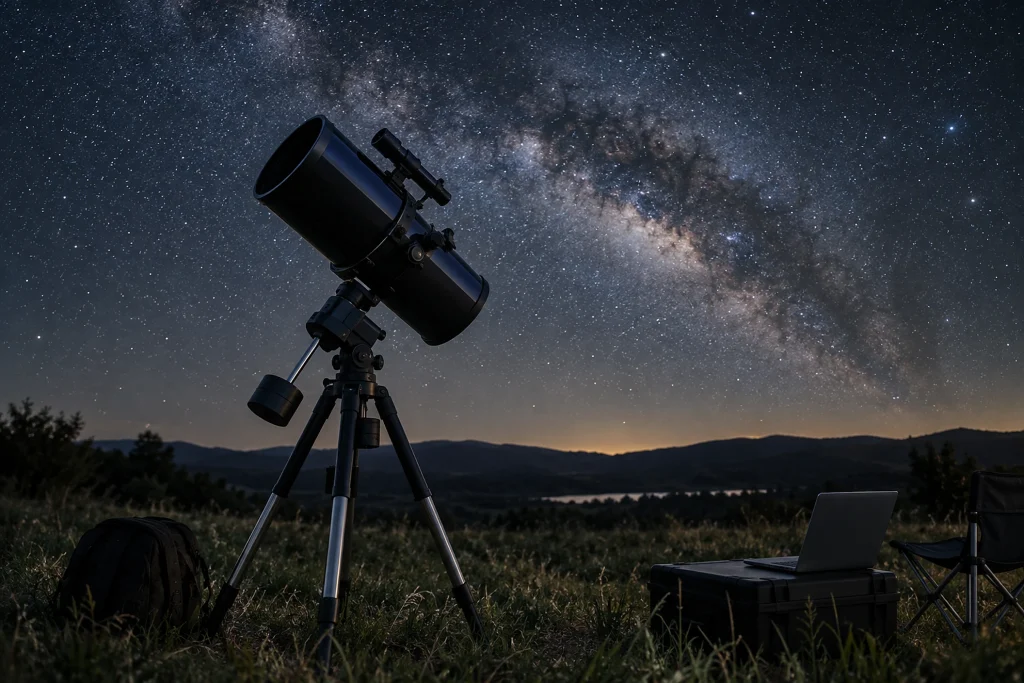
The author, who has observed two total solar eclipses, is focusing on a similar phenomenon: asteroid occultations. In this event, which occurs when an asteroid blocks the light of a distant star as seen from Earth, the shadow moving across Earth—which can be several hundred meters wide—travels at a speed of dozens of kilometers per second. Amateur observers can measure the shadow by being in the right place at the right time and, with sufficient observations, can map the asteroid’s shape. A large telescope is not required when bright stars are involved.
The equipment used by the author is as follows:
- 5.1-inch-aperture (130-millimeter) Newtonian telescope: approximately US $300
- Small equatorial mount powered by stepper motors: $150; it uses the open-source OnStep controller. Motorized mounts start at $300.
- Color astronomy camera with a Sony IMX585 sensor for imaging: $260
- As a cheaper option, a monochrome ToupTek G3M662M with a smaller sensor: approximately $200
The local timing of an occultation can be calculated using free PC software available on the International Occultation Timing Association (IOTA) website. Those who want to submit their observations to IOTA need to calibrate the timing of their images; computer timestamps can be inaccurate. For this purpose, a flasher with a red LED is used, operating with the signal produced once per second by GPS. The system consists of a GPS module, an Arduino nano, and an LED; timing uncertainty can be reduced to a few milliseconds. The author recommends a different GPS module that accepts an external active antenna.
Background
DIY is not a new name in the FikirPilot archive: we have published 3 news articles mentioning this name in the last 90 days; the most recent is dated September 19, 2026.