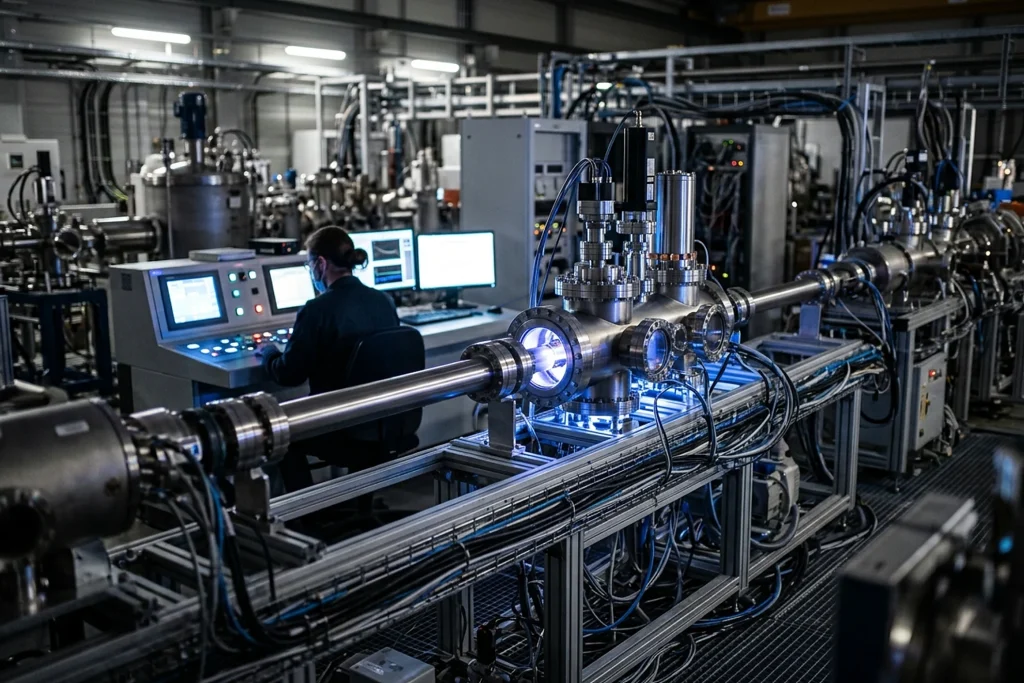
The first experiment has been conducted at TARLA, Türkiye’s domestic particle accelerator. The Turkish Accelerator and Radiation Laboratory (TARLA), operating under Ankara University, has successfully completed its first material irradiation experiment using its own domestic infrastructure. The first results have emerged. During the experiment, gamma rays produced from high-energy electrons with the domestic particle accelerator infrastructure were applied in a controlled manner to glass and plexiglass samples. Changes were observed in the samples. Examinations revealed a marked change in the color of the glass sample, along with deterioration and fractures in the internal structure of the plexiglass. This work demonstrates that Türkiye can now study the effects of radiation on materials under controlled conditions using its own accelerator.
Particle accelerators are complex systems that bring subatomic particles such as electrons to high speeds and energy levels, producing the high-quality radiation that research requires. TARLA has delivered this capability. The capability TARLA provides paves the way for domestic testing processes in fields ranging from satellites to mobile phones, and in both the defense industry and the health sector. Its area of contribution is broad. It will contribute to the more durable design of optical systems and sensors, alongside satellite lenses that are exposed to intense radiation in space. This capability will also make it possible to carry out work aimed at making radiation-damaged materials reusable.
Preliminary studies are being planned. These studies, to be conducted at TARLA on radioactive substances used in cancer diagnosis and treatment, will lay the groundwork for domestic nuclear medicine technologies.
Why it matters
Until this experiment, institutions in Turkey that wanted to examine the behavior of materials under radiation in controlled conditions were dependent on accelerator infrastructures abroad; the capability demonstrated by TARLA eliminates this dependence. The segment most directly affected will be the teams designing satellite lenses, optical systems, and sensors that are exposed to intense radiation in space, together with manufacturers seeking to move their testing processes in the defense and electronics fields back within the country. On the health side, work on radioactive substances used in cancer diagnosis and treatment is still in the planning stage; the contribution to nuclear medicine is therefore not a result to be seen today but a matter of infrastructure preparation. The first observations on glass and plexiglass show that the facility is operational, but the question of when this capacity will turn into a regular, industry-oriented testing service remains open.
Background
Turkey is not a new name in the FikirPilot archive: in the last 90 days we have published 100 news items mentioning this name; the most recent is dated October 21, 2026.