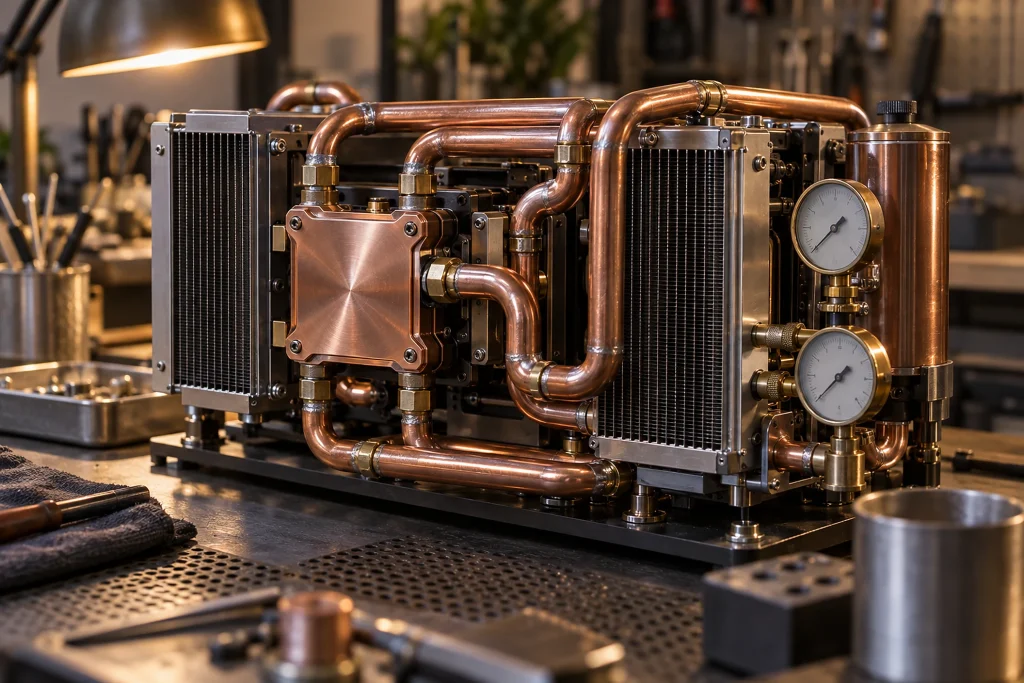
Billet Labs’ work builds a fanless, aluminum-block-based system for a silent PC without sacrificing performance. While parts left over from the previous attempt were handcrafted into a steampunk look, thermal paste was placed beneath the flex ATX power supply and a 6mm thermal pad beneath the motherboard. Three radiators were used in the cooling loop:
- One large, one small, and one slightly smaller radiator.
- Their paint was removed and they were polished, then stacked horizontally on top of the motherboard using handmade brackets.
Soldered household copper pipes were used instead of standard tubing. The gauges at the front monitored water pressure and temperature; soldering the reservoir, consisting of a fill cap and a pipe connected to the pump, proved difficult because of the large pipe’s thermal mass. During testing, the pressure gauge made noise and the radiators proved insufficient. However, the aluminum block cooled the motherboard and GPU well. Once a 120mm fan was added between the small radiators and the pressure gauge was removed, the problems were resolved and a silent, high-performance living-room PC was achieved.
Why it matters
This project shows that achieving a silent computer involves more than simply eliminating the fans; the surfaces, connections, and radiator arrangement needed to distribute heat throughout the system must be designed together. The problems that emerged during testing demonstrate that cooling capacity is a decisive factor in its own right, even in a case that appears to be custom-built. The fact that the solution relied on adding a single fan between the small radiators shows that the project evolved from a completely fanless design into a low-noise one. Therefore, the project demonstrates that those seeking to build a similar living-room PC or a DIY system face a practical choice between silence and thermal reliability, while the removal of the pressure gauge also shows that monitoring features can be given lower priority depending on the design goals.