When COVID-19 emerged, scientists knew the virus’s key proteins thanks to decades of coronavirus research and were able to design vaccines in record time. This advantage may not be available in future pandemics.
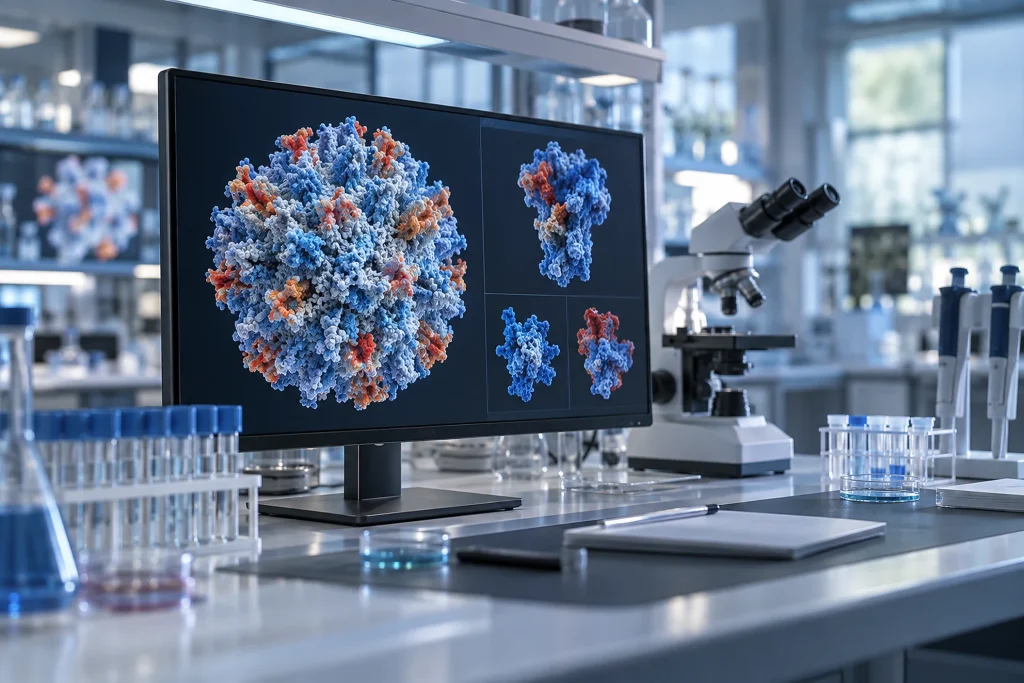
To strengthen this preparedness, NVIDIA collaborated with global research organizations, including Google DeepMind and the European Molecular Biology Laboratory’s European Bioinformatics Institute (EMBL-EBI), to make predicted 3D structures of the protein complexes of more than 2,800 viruses openly accessible through the AlphaFold Database. The structures were generated using Google DeepMind’s AlphaFold2 model, which predicts protein folding, and the NVIDIA BioNeMo Inference Runtime. The system predicted interacting protein groups across thousands of viral proteomes at scale.
NVIDIA also released the GPU-accelerated BioNeMo Structure Prediction Pipeline, which enables researchers to go from a protein sequence to a predicted 3D structure. Approximately 30% of the protein interactions added to the database are entirely new to science; these structures had not previously been documented in the Protein Data Bank.
According to an analysis by the Center for Global Development, the probability that the world will face a pandemic as severe as COVID-19 by 2050 is approximately 50%. The project partners aim to build up knowledge in advance about viruses that may emerge in the future and for which existing knowledge may not be available.
Protein complexes can be targets for vaccines and drugs. While traditional structure determination can take years, AlphaFold2 can make predictions in minutes on NVIDIA GPUs.
Why it matters
This resource aims to enable researchers to refer to a pre-existing protein map during an outbreak instead of starting from scratch. Particularly for teams developing vaccines and drugs, seeing interacting groups of proteins together provides a starting point that could accelerate the evaluation of potential targets. The fact that approximately one-third of the structures consist of information not found in the Protein Data Bank shows that the study does not merely compile existing data but also opens up new areas for investigation on the research agenda. The open publication of the workflow, meanwhile, allows different researchers to obtain predicted structures from protein sequences, ensuring that the resource’s use is not dependent on a single institution; however, the question of which of these predictions will be validated as vaccine or drug targets remains open.