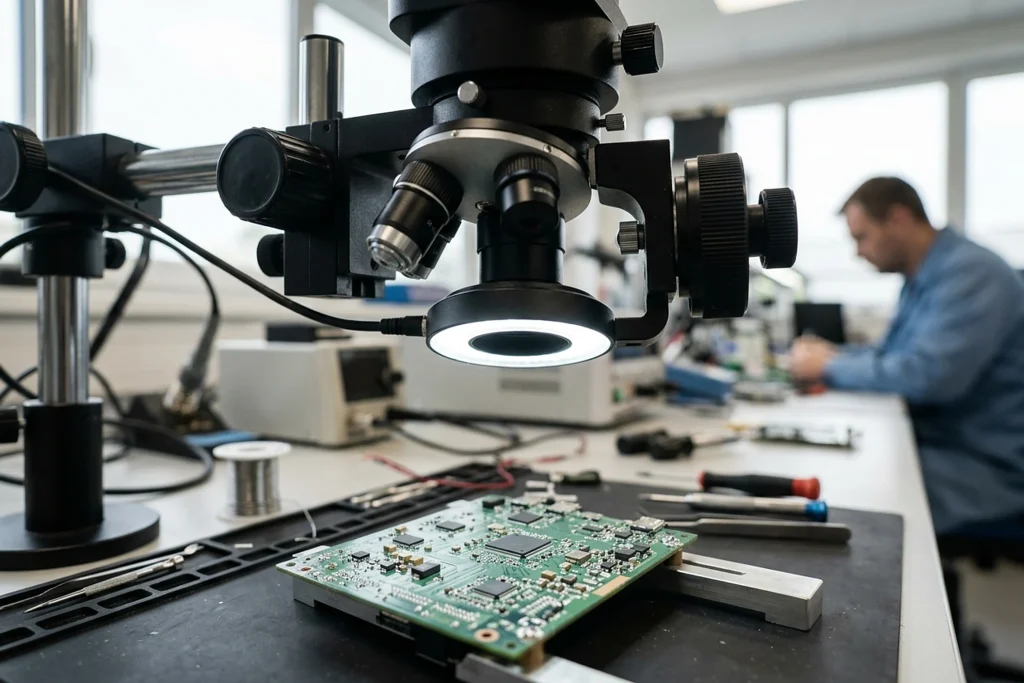
Microscope Offering 3D Imaging The development effort began when Corebb, who found the top-down view insufficient while examining solder joints, developed his own microscope that provides a rotating side view. The device consists of two main parts. In the system, which is made up of a commercial C-mount lens assembly and a USB camera, an LED ring provides illumination, while two polarization filters set at 90 degrees to each other eliminate glare on reflective surfaces. An adapter was designed for the side view. The adapter, which attaches to the microscope with magnets and preserves optical alignment, optically directs the side view straight into the main lens via a pair of mirrors. A concave lens compensates for the extended optical path. Ball bearings allow rotation from every angle, but when the 3D printing caused vibration due to flexing, the system switched to machined aluminum, and shadows were also reduced. The design appears far more cost-effective than its predecessors.
Why it matters
Born from the inadequacy of inspecting solder joints from above, this project shows that the need for a side-angle setup is rooted in workshop practice; since the device is built with off-the-shelf components such as a commercial C-mount lens assembly and a USB camera, it offers a path that makers facing the same problem can follow. The elimination of glare on reflective surfaces with two polarization filters perpendicular to each other demonstrates that in work where reflective materials are examined, such as solder inspection, lighting management is as decisive as the optical arrangement. The switch to machined aluminum after 3D printing caused vibration due to flexing, together with the reduction in shadows that came with this change, exemplifies how the manufacturing method directly affects optical performance. Although the design is said to be far more cost-effective than its predecessors, the absence of any figures in the report leaves the true extent of the price advantage unclear.